Computational Movement Disorders Lab
Quantitative human motor neuroscience across health and disease
We study human movement as a high-dimensional behavioural output of the nervous system, combining quantitative movement tracking, wireless neurophysiology, and computational modelling to understand how motor control is organised and how it is altered in neurological disease. A central goal of the lab is to develop rigorous, reproducible methods for measuring behaviour in naturalistic settings and to build mechanistic accounts that link circuit-level function to observable action, modelling movement disorders as perturbations of motor control. Insights from this work inform our understanding of disease mechanisms and support the development and evaluation of targeted neurorehabilitation and neuromodulatory strategies.
We are an interdisciplinary group based at the Gatsby Computational Neuroscience Unit, with experimental work conducted in purpose-built human movement laboratories in the Department of Motor Neuroscience and Movement Disorders. Our research sits at the interface of human motor neuroscience, computational neuroscience, and experimental methods development, with a strong emphasis on open, reproducible tools and datasets that lower barriers to quantitative movement research and enable reuse across laboratories, disciplines, and settings.
news
| Oct 07, 2026 | Anna will speak at the International Congress of Parkinson’s Disease and Movement Disorders in Seoul, Korea on The Neural Bases of Dystonia. |
|---|---|
| Jun 10, 2026 | Anna will present current lab work at the UCL Queen Square Movement Disorders Centre Symposium , which brings together researchers and clinicians to discuss advances in understanding and treating movement disorders. |
| May 04, 2026 | A busy period for lab presentations: Anna and Iván presented recent work at the SWC/GCNU Symposium. Issi will be presenting at the upcoming Association of British Neurologists Annual Meeting. Mireia, Kate and Issi will also be presenting at the European Academy of Neurology Congress in Geneva. |
| Mar 12, 2026 | It was great to visit the Champalimaud Centre for the Unknown to give a talk during COSYNE. Many thanks to Marcelo Mendonça, Joaquim Alves da Silva and colleagues for the warm welcome. An outstanding and beautiful centre for interdisciplinary science and neurotechnology. |
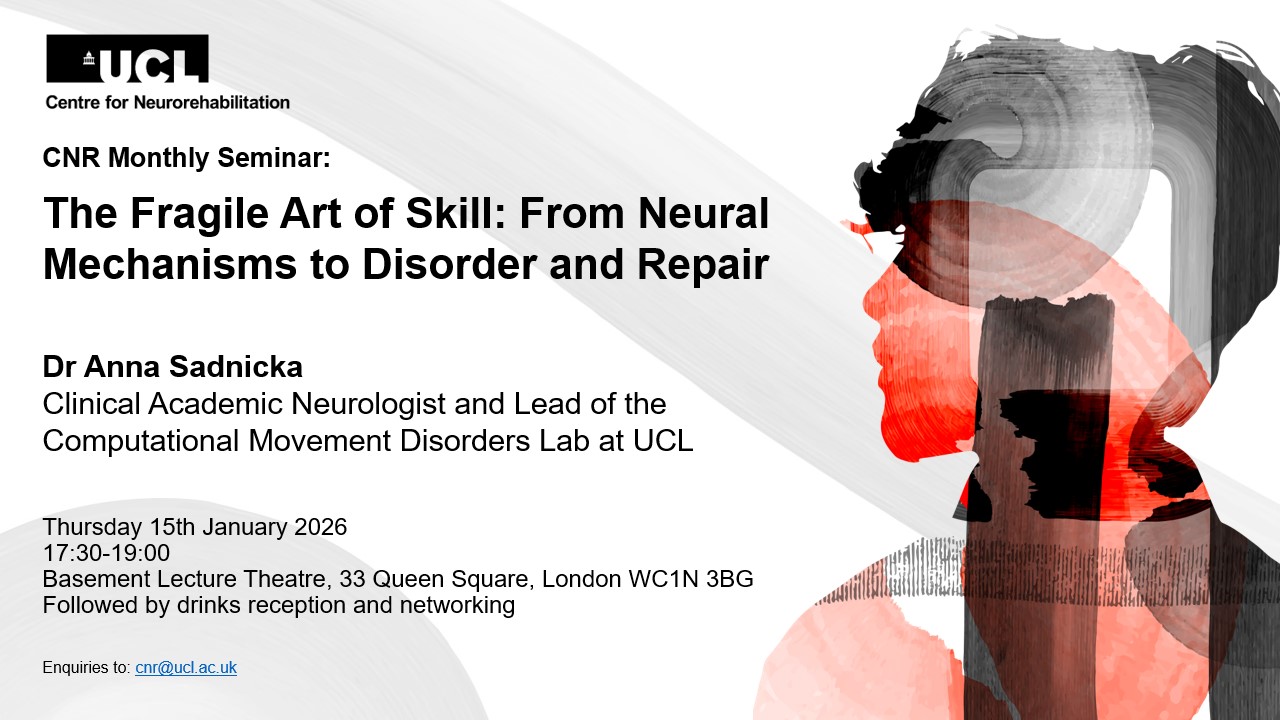
| Jan 15, 2026 | Anna gave a talk The Fragile Art of Skill at the UCL Centre for Neurorehabilitation Monthly Seminar. This work brought together insights into how skills are learned, how they break down in disease, and how they might be restored. |
| Dec 19, 2025 | 🎉 Award news! Our collaboration with NeuroGEARS on scalable behavioural acquisition systems has been recognised with the Meta Reality Labs Motor Learning and Ethical Design Award. Congratulations to Iván and Marta for showcasing the work so well. |
| Dec 16, 2025 | At the Neurophysiological Bases of Human Movement (16–17 December, King’s College London). Anna gave a talk on Phenomenology in Human Movement Disorders and took part in a panel discussion exploring black-box versus mechanistic modes of scientific discovery. |
| Dec 11, 2025 | At Advances in Motor Learning II (11–12 December). Mireia and Issi presented Decoding Rating Scales in Movement Disorders, and Marta and Iván summarised ongoing work on Building Scalable Tech for Human Behavioural Sampling. Anna delivered a keynote on task-specific dystonia and took part in a panel discussion on how to better integrate moderm ML methods and technologies into human motor science in halth and disease. |
| Jul 23, 2025 | Congratulations to Kate on being awarded a prestigious NIHR Predoctoral Fellowship to advance research into the mechanistic basis of neurophysiotherapy interventions for dystonia. |
| May 23, 2025 |  We have received an Innovation Fund Award from the National Brain Appeal to develop scalable motion capture systems in collaboration with NeuroGEARS! We have received an Innovation Fund Award from the National Brain Appeal to develop scalable motion capture systems in collaboration with NeuroGEARS! |
| May 21, 2025 | UCL Research Capital Investment Fund (RCIF) have a awarded us a grant for further equipment in the lab! |
| Jan 08, 2025 | A hot topic article for Movement Disorders showcased scientific work by Smoulder et al. revealing a neural basis for choking under pressure. Informative for neurological disorders such as task-specific dystonia. |
| Jul 22, 2024 | Paper in Nature Scientific Reports discussing whether sensitive markers of dexterity could be biomarkers for different stages of task-specific dystonia. |
| Sep 08, 2023 | Symposium on the Neuroscience of Expert Performance at the Royal College of Music, co-organised with Maria Herrojo Ruiz and Katja Kornysheva. Many thanks to the panel, RCM colleagues and our multidisciplinary audience. The event was made possible by outreach grants from the Guarantors of Brain and Goldsmiths, University of London. |
| Sep 01, 2023 | Article with Mark Edwards debates significance of clinical phenotype and how circuit-level understanding is critical to optimise treatment strategies in patients: Between Nothing and Everything: Phenomenology in Movement Disorders |